How to Brew a Better Cup with a French Press
Words by Oliver Hart ·
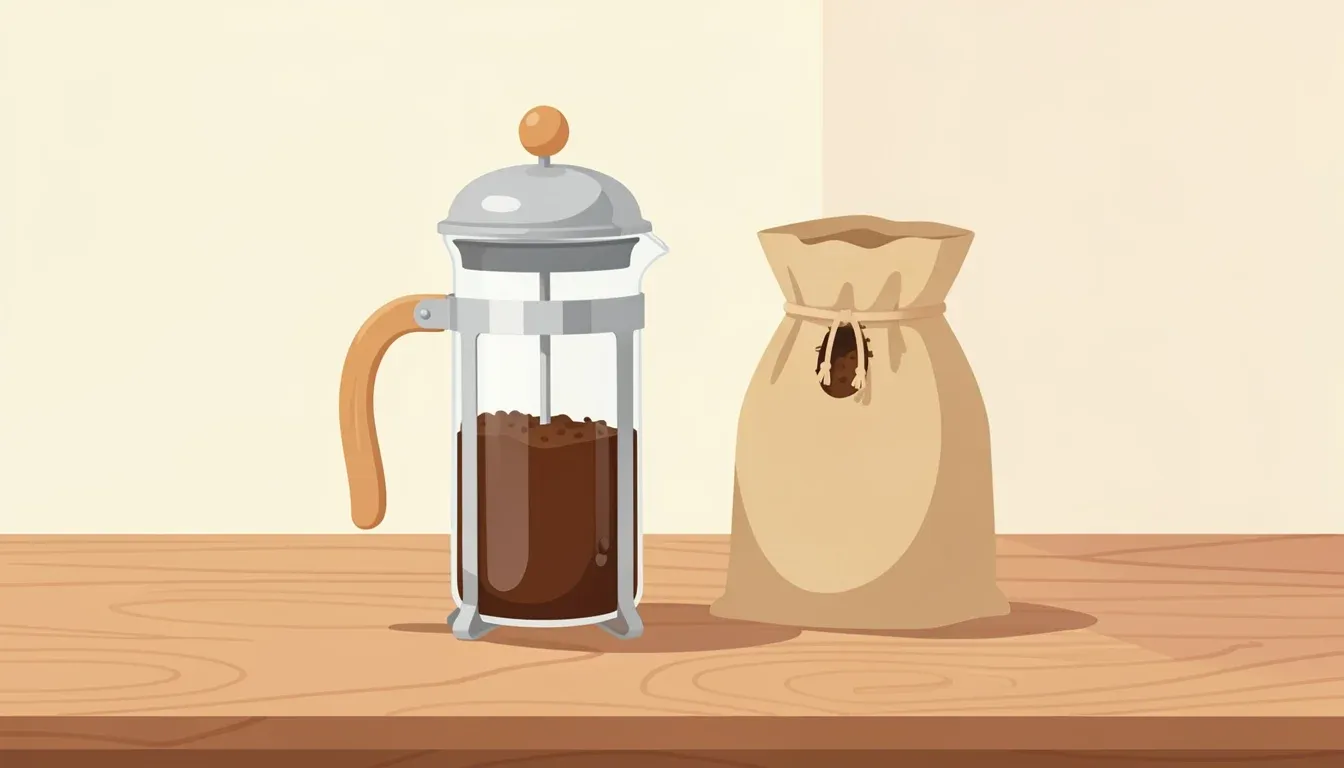
What you need before you start
A French press is forgiving, which is why it works on a crowded kitchen counter. You need the press itself, a grinder that can produce a coarse grind, a kitchen scale, and a kettle. A timer helps, but a phone on the worktop will do.
The grind matters more than anything else on this list. Aim for something close to coarse sea salt or breadcrumbs. If the grounds feel like fine sand, they will slip through the mesh filter, and the bottom of the cup will taste muddy and bitter. Blade grinders chop unevenly. If that is all you have, pulse in short bursts, shake the grinder between pulses, and sieve out the dust if you can.
For a standard 1-litre press, start with about 60 grams of coffee and 1 litre of water, a ratio of roughly 1:17. Treat this as a starting point, not a rule. Stronger cups can go to around 1:15, and lighter ones to 1:18. Write down what you did for the first few brews so you can tell which change made the difference.
The brewing sequence
Follow these steps in order. Once the routine is familiar, it takes under six minutes from kettle to cup.
- Boil the kettle, then leave the water for about 30 seconds. You want it somewhere near 93 to 95°C. Water straight off the boil can scorch the grounds and make the cup harsh.
- Place the empty carafe on the scale, tare it, and add the ground coffee. Set the plunger aside with the lid off so the filter stays clean.
- Start the timer and pour in just enough water to wet the grounds, about twice their weight. Wait 30 seconds. This is the bloom, when the coffee releases gas and swells up.
- Fill to your target weight in one steady pour. Stir the surface gently with a wooden or plastic spoon so no dry grounds cling to the sides.
- Place the lid on with the plunger pulled up, not pressed down. Let it steep for four minutes.
- At four minutes, remove the lid and skim the foam and floating grounds off the surface. This crust is loose debris. Clearing it keeps fine particles out of the final cup.
- Press the plunger down slowly and evenly over 20 to 30 seconds. If it pushes down with hard resistance, the grind is probably too fine. If it drops with no resistance at all, the brew may be under-extracted.
- Pour everything out of the carafe straight away. Coffee left sitting on the grounds keeps extracting, and within a few minutes it turns astringent.
Adjusting the cup to your taste
Taste before you change anything. A French press brew is supposed to be full-bodied and a little heavy, so a thick texture alone is not a fault. What matters is whether the flavour is balanced.
If the cup tastes sour, thin, or grassy, the coffee is under-extracted. Grind a touch finer, or let it steep for an extra 30 seconds. If it tastes bitter, dry, or hollow, the opposite is true. Go slightly coarser, shorten the steep, or let the water cool a little longer before you pour.
Silt at the bottom of the cup usually means one of three things. The grind may be too fine, you may have pressed too hard, or the mesh may be worn or clogged. Change one variable at a time, or you will not know which fix worked.
What to check at the end
Clean the press while the grounds are still warm, because they come away more easily. Tip the spent grounds out, rinse the carafe, and run water through the mesh filter. Oil builds up on the mesh over time and turns stale, so take the filter apart every week or so and wash it properly.
Before your next brew, run through this short list:
- Is the water closer to 93°C than to a rolling boil?
- Is the grind coarse enough that it looks like breadcrumbs, not flour?
- Did you skim the crust before pressing?
- Did you pour out the whole cup as soon as you pressed?
- Is the mesh filter clean and free of old coffee oil?